
 eCom
eCom Visitor experience
.svg) Marketing
Marketing Insights
 Platform
 Integrations
 Themepark
 Zoo
Zoo Museum
 Waterpark
 Convious Library
 Blog
Blog eBooks
 Magazine
 Success Stories
 Webinars
 Videos
 About Convious
 Contact
 Press & Media
As global AI spending exceeds $2 trillion, the experience economy is all about competing with digital noise, high interaction costs, and friction-filled booking flows. AI adoption has moved from experiment to economic priority: the UK Government, through its DCMS-commissioned research with EY, has formally tracked AI adoption and its barriers across the private sector since 2021. By early 2026, just over 50% of UK businesses treat AI as an important long-term strategic goal, with operational efficiency the leading priority.
Attractions such as zoos, theme parks, and museums sit on large volumes of behavioural data. Traditional analysis cannot act on this data quickly enough to change a price, redirect a queue, or trigger an offer while the visitor is still deciding. However, deploying AI to solve this is not as simple as flipping a switch.
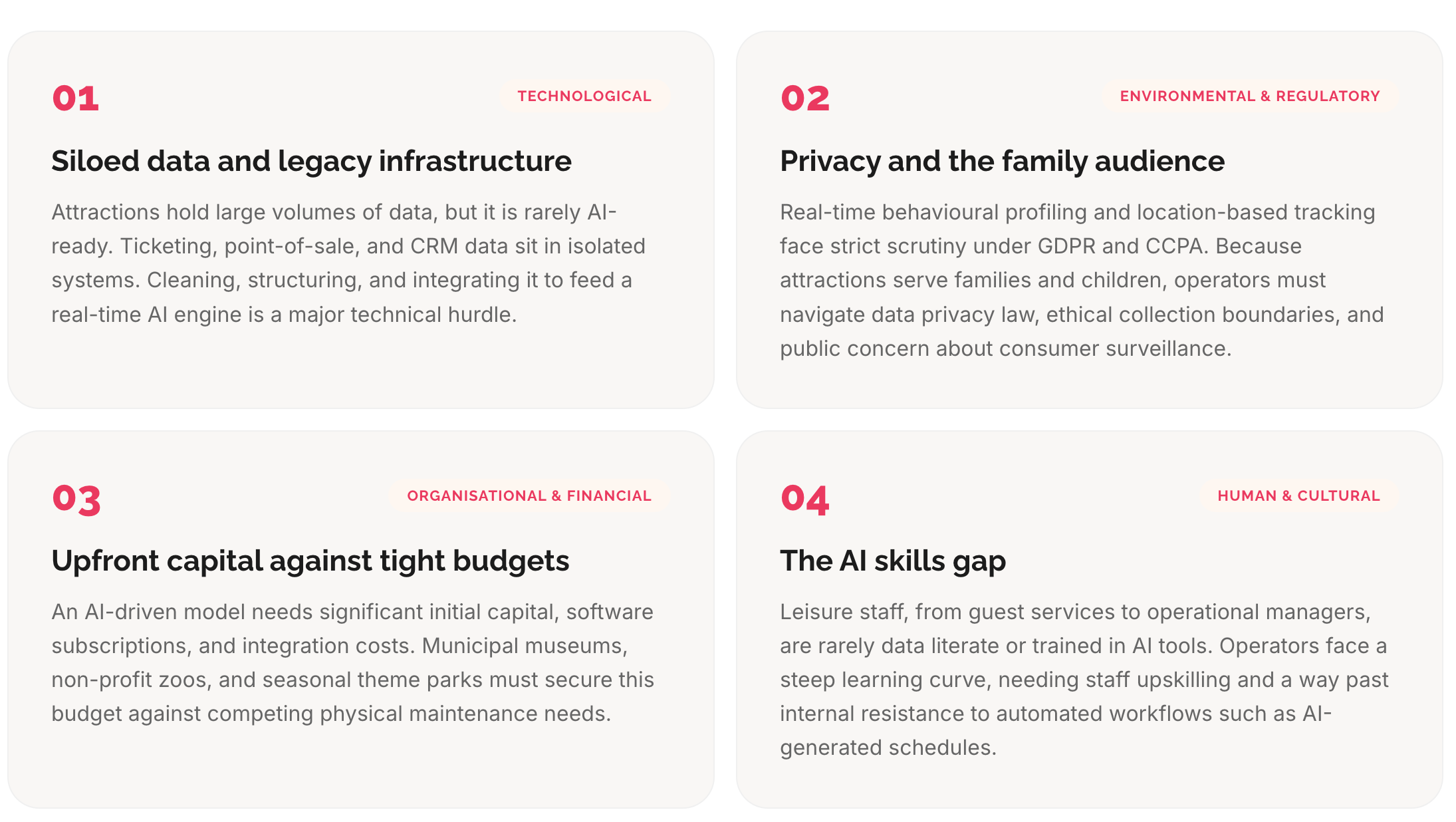
The four challenges operators must overcome before deploying AI:
AI for Increasing Revenue
AI increases revenue in the leisure industry by personalising what each visitor sees and pays in real time, based on their behaviour and the venue's live demand. Four applications stand out:
Personalised on-the-fly offers. AI builds a profile of each website visitor as they browse and presents a tailored offer, increasing the likelihood of conversion.
AI-driven dynamic pricing. A demand-based pricing feature lets the venue adjust ticket prices automatically in response to real-time demand, the core of AI-powered revenue management. Beyond lifting revenue, it smooths attendance by shifting price-sensitive guests from peak to off-peak periods. The direction of travel is clear even among premium operators. In November 2025, Disney's CFO confirmed the company is extending dynamic pricing to its domestic theme parks to boost incremental revenue, after a successful year-long trial at Disneyland Paris.
(See how dynamic pricing works in our 5 Emerging Trends in the Leisure Industry guide.)
Location-based social targeting. AI can target potential visitors on social media at the moment they check in at nearby shops, hotels, or attractions, capturing demand close to the point of decision.
Behaviour-based after-sales campaigns. AI builds personalised post-visit email campaigns from each guest's on-site behaviour to win more returning visitors.
AI for Reducing Costs
AI reduces operating costs in the leisure industry by automating routine service tasks and matching resources to predicted demand. Two applications are immediately practical:
Customer-service chatbots. An AI chatbot answers visitor questions on the website around the clock. Studies by Uzoka et al. (2024) reveal that chatbots can handle up to 70% of routine customer inquiries, allowing human agents to focus on more complex issues, thereby increasing overall efficiency.
Demand-based staffing. By feeding flexible variables such as weather and social-media trends into operational dashboards, AI helps managers predict how many staff to deploy on a given day, avoiding both overstaffing and understaffing.
AI for Enhancing Visitor Satisfaction
AI enhances visitor satisfaction in the leisure industry by personalising the on-site experience and managing how guests move through the venue. Three applications apply directly to zoos, parks, and museums:
Optimised animal feeding times. For zoos, AI can combine animals' natural eating patterns with peak visitor times, so feeding happens when the most guests are present to watch.
AI-driven crowd control and dynamic routing. AI manages visitor flow by offering different dynamic routes through the venue, easing congestion and shortening queues. (For a real-world example, see how Movie Park Germany used Convious Crowd Control to manage visitor flow.)
Personalised on-site content. AI can deliver a personalised explanation at each animal enclosure, exhibit, or attraction, tailored to the individual visitor's interests.
AI for Understanding Your Visitors
AI helps leisure operators understand their visitors by collecting behavioural data through engaging on-site experiences:
Gamified data collection. Offering visitors fun, educational games within the venue encourages engagement while gathering data on their interests and behaviour, insight that feeds every other AI application above.
Turning AI Insight into Action
The common thread across all ten applications is reacting to data in real time rather than analysing it months later. That is what AI delivers to the leisure industry: faster insight, more personalised guest experiences, and higher profit. As AI adoption becomes the defining trend shaping attractions in 2026, operators that build these capabilities into their ticketing, pricing, and visitor-experience systems will lead the field.
Interested in learning more? Read our blog post AI 101 - Artificial Intelligence for Business and Marketing Professionals.

Convious is an AI-driven, all-in-one e-commerce platform specifically designed for the leisure and attractions industry, such as theme parks, zoos, and museums. It enables operators to manage ticketing, dynamic pricing, and visitor engagement in one place to increase conversions and enhance the guest experience from booking to visit. With our eCom, Self-service Kiosks, and Point-of-Sale solutions, we turn first-time visitors into long-time loyals.
Share what you love


